











Quick question. When was the last time you sat down on the floor, and then stood back up again, without using your hands?
If you just did it in your kitchen to check, we love you. If you just thought “ummm… why would I ever do that?”, keep reading, because it turns out this exact little movement tells you a surprising amount about how your body is ageing.
Here’s the thing about longevity. Most of the conversation is about living longer, which is lovely, but honestly? Not the point. The point is being able to get down on the floor to play with your grandkids and get back up again without a whole production. Carrying your own shopping in one trip. Standing up from a low couch without making that noise. (You know the noise.)
That’s longevity. Not extra years, but good years. Years where your body says yes.
And the beautiful thing is you don’t need a lab, a fancy watch or a blood test to get a sense of where you’re at. There are four simple movement tests you can do right now, in your living room, in about five minutes. So grab a chair, and let’s go. Do the test here or keep reading and follow along!
What actually predicts ageing well
When researchers look at what keeps people independent and mobile into their 70s, 80s and beyond, the same few things keep showing up. And none of them are complicated.
Strength. Specifically leg strength. It’s what gets you off the couch, up the stairs and out of the car. We lose muscle as we age (it starts far earlier than most of us realise), but it’s also the thing that responds fastest when you start moving again.
Balance. Deeply underrated. Balance is the difference between a wobble and a fall, and falls are one of the biggest things that change a person’s life in their later years. The very good news is balance is a skill, and skills can be practised at any age.
Mobility. How freely you move through your normal day. Reaching the top shelf, looking over your shoulder to reverse the car, bending down to tie your shoes.
And then there’s a fourth one that nobody puts on a poster: consistency. Not how hard you train. How regularly you move. A gentle twenty minutes most days will do far more for your next thirty years than an epic workout you do twice and then abandon because you can’t walk properly.
The four tests below check the first three. We’ll come back to the fourth one, because it’s the one that actually decides everything.
Test 1: The Sit to Stand Test

What to do: Sit on a chair without armrests. Cross your arms over your chest. Set a timer for 30 seconds and count how many times you can fully stand up and sit back down.
Roughly how it goes:
- 15 or more times – excellent lower body strength
- 12 to 14 times – strong
- 9 to 11 times – solid, with room to build
- 5 to 8 times – worth some attention
- Under 5 – a great place to start
What it’s telling you: this is a classic measure of lower body strength and endurance, and it’s used by physios and researchers because it’s simple and it correlates well with how independent people stay as they age. Every single time you stand up from a chair you’re doing a bodyweight squat. You just don’t call it that.
If you want to improve it: squats, obviously, but you don’t have to load up a barbell. Chair squats, slow controlled sit-to-stands, Pilates leg work. Anything that has you moving through that hip and knee bend under control.
Test 2: The Floor Test
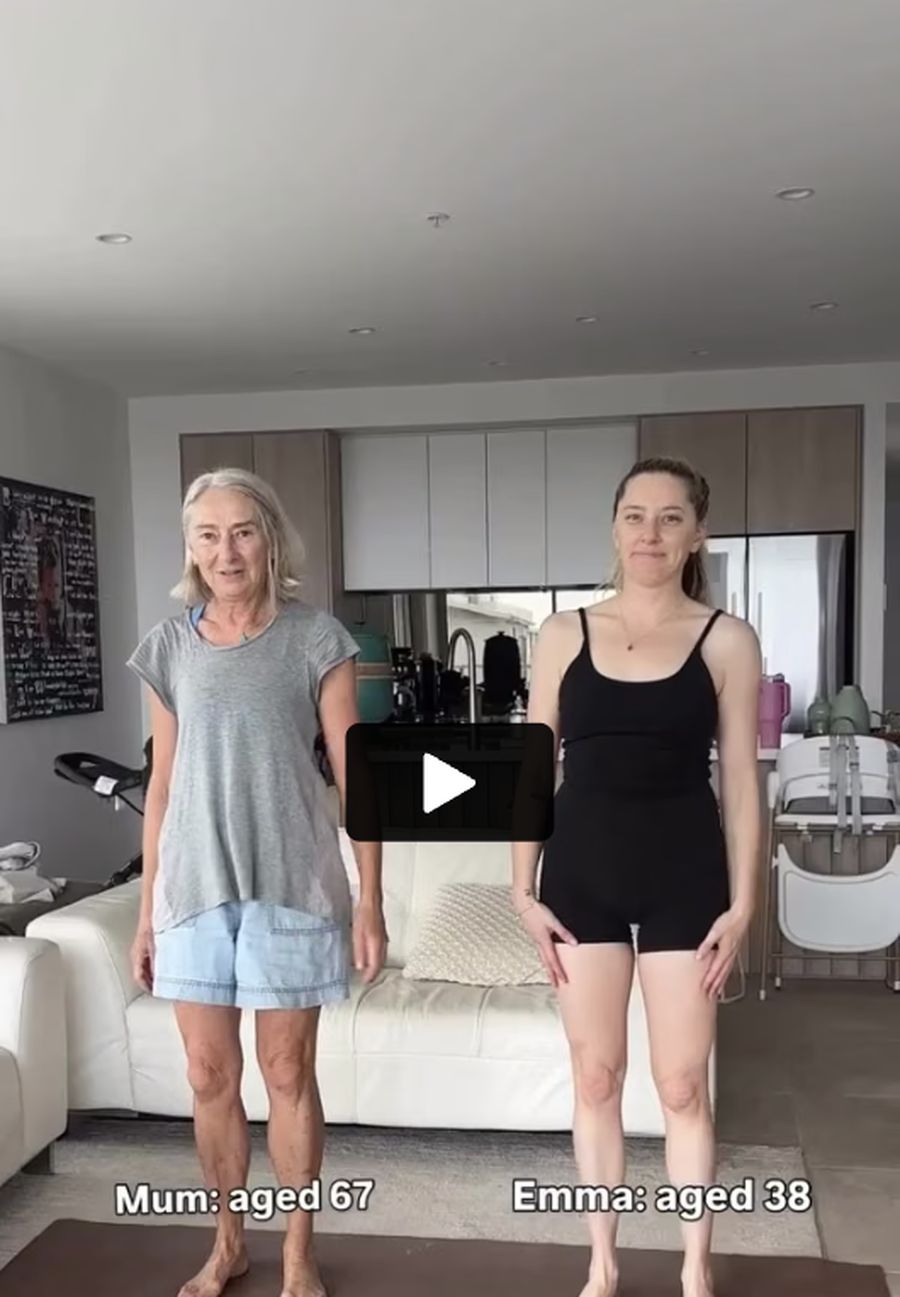
This is what we talked about earlier.
What to do: From standing, lower yourself down to your knees and then sit on the floor, then stand back up again. Try not to use your hands or any support. Have a chair nearby just in case, and please don’t force it.
How did you go? No hands at all? Used one hand briefly? Both hands? Needed a chair? Couldn’t quite get there?
What it’s telling you: this one is sneaky because it’s not testing a single thing. To get down and up without hands you need leg strength, hip mobility, ankle mobility, core control and coordination, all at once, in sequence. It’s a whole-body test disguised as a party trick.
And here’s the bit we want to say loudly: needing your hands does not mean you’re old. It usually means you haven’t practised this pattern in years. Most of us stopped sitting on the floor somewhere around the time we got a proper couch. Bodies are very good at dropping the things we never ask them to do.
If you want to improve it: sit on the floor more. Easy. Watch telly on the floor. Cross legged, kneeling, legs out long, switch it up. Add some hip openers and some squat work and this test changes surprisingly quick. Also if you didn’t realise… Yin Yoga is the best for this!
Test 3: The Single Leg Balance Test

What to do: Stand on one leg, eyes open, and time how long you can hold it. Up to 30 seconds. Arms out is fine. Have something nearby to grab. Then, if you’re feeling brave, try it with your eyes closed (it is dramatically harder, don’t panic).
Roughly how it goes:
- 30 seconds or more – lovely
- 20 to 29 seconds – good
- 10 to 19 seconds – worth practising
- 5 to 9 seconds – definitely worth practising
- Under 5 seconds – start here, it improves fast
What it’s telling you: balance relies on a conversation between your inner ear, your eyes, and the sensors in your feet and joints. When you close your eyes you take one of those away, which is why it gets so much harder. Balance tends to fade with age mostly because we stop challenging it.
If you want to improve it: this is the easiest one to sneak into your day. Stand on one leg while the kettle boils. While you brush your teeth. While you wait for the toaster. Thirty seconds each side, twice a day, and you’ll notice a difference within a couple of weeks. Yoga is brilliant for this too, all those standing postures are balance training in disguise.
Test 4: The Toe Touch Test

What to do: Stand with your legs straight (a micro bend in the knees is completely fine), then bend forward and reach down towards your toes. Where do your hands land?
Roughly how it goes: palms flat on the floor, fingertips to the floor, fingertips to ankles, hands to shins, or hands to knees and above.
What it’s telling you: this checks the flexibility of the whole back line of your body, hamstrings, calves, lower back. And before anyone spirals, touching your toes is not a moral achievement. Some people have long femurs. Some people have short arms.
What matters is whether stiffness is limiting your actual life. If bending to pick something up feels like a negotiation, that’s the useful signal.
If you want to improve it: gentle, regular forward folds beat aggressive occasional stretching every time. Yin yoga is wonderful here because the long holds reach the deeper tissue that a quick 20 second stretch never touches.
The three things a movement test can’t measure
So you’ve done the four tests. You’ve got a rough picture. But here’s where a blog post doesn’t help.
Because how well you age isn’t just about what your body can do once. Three other things matter enormously, and none of them show up in a sit to stand count.
Your stress and your ability to feel calm. Chronic stress affects your sleep, your recovery, your hormones, your appetite, your mood, your motivation to move at all. You cannot out-exercise a nervous system that never gets to switch off.
Your energy through the day. Not “can you do a hard workout”, but do you have enough left at 4pm to do the things you actually want to do?
Your consistency. The big one. Somebody who moves four times a week for years will age far better than somebody who goes extremely hard for six weeks every January and then does nothing.
Those three, combined with your four physical results, are what give you the full picture. And that’s exactly what our Longevity Test does.
It walks you through the same four physical tests, plus three quick reflections on your stress, energy and movement habits. It takes about five minutes, scores the whole lot together, and gives you a personalised report telling you where you’re strong, where your biggest opportunity is, and what to actually do about it.
→ Take the free 5-minute Longevity Test here
It’s free, there’s no equipment, and you can do it in your living room right now.
What to do with your results
Whatever your results, please don’t treat them as a verdict. They’re a starting point, and every single one of these is trainable.
If strength was your weak spot, start there. Pilates is strength training, and it’s one of the best ways to start moving again if you’ve been out of movement for a while.
If balance is your weak spot, yoga is your friend. Standing postures, practised regularly.
If mobility was the one, slow and consistent wins. Yin, gentle flows, and sitting on the floor more often than you currently do.
If stress and energy were the real story, be honest about that. Sometimes the most useful thing you can do for your long-term health is a slow twenty minute practice that calms your whole system down, not a punishing session that adds to the load.
And if consistency is your sticking point, welcome, that’s most people. It’s also the single highest-value thing you could change.
That’s exactly why we built MerryBody the way we did. Yoga, Pilates and meditation classes from 10 to 30 minutes, no complicated equipment, no judgement, no six-week-shred nonsense. Designed to fit your real life so you can finally be consistent. Because consistency is the thing that pays you back in thirty years.
You might also like why Pilates is such brilliant anti-ageing exercise, whether yoga strengthens your bones, and why yoga is so good if you’re over 60.
Frequently asked questions
What age should I start caring about this?
Now, whatever now is. Strength and balance start declining earlier than most people expect, but they also respond at any age. There is genuinely no version of this where it’s too late.
Is this a medical test?
No, and we want to be really clear about that. These are simple functional tests used widely by physios and in research, but doing them at home is a self-assessment, not a diagnosis. If something hurts, or you have an existing injury or condition, check in with your doctor or physio first.
I couldn’t do one of them at all. Should I be worried?
No. It means you’ve found your starting point, which is far more useful than not knowing. Start where you are.
How often should I retest?
Every 8 to 12 weeks. It’s a lovely way to see progress that doesn’t involve scales, and honestly, watching your balance time climb is very satisfying.
Do I need any equipment?
A chair and a timer. That’s it.
Give it a go
Five minutes. Four movements. A much clearer picture of how your body is actually travelling, and what to do next.
→ Take the free Longevity Test and get your personalised plan
And then go and sit on the floor. Your future self will thank you.
Always merrymaking,
Emma + Carla